Hello there! I'm Sebastian đź‘‹
I'm a computational physicist with a background in statistical data analysis and numerical simulations. I'm currently transitioning into data science and machine learning. This is my personal page — you'll find my projects, publications, and a bit about me below.
projects
Below is a selection of my projects. The full list is available on GitHub.
statpy
Python toolkit targeted at Markov Chain Monte Carlo data analysis in the context of lattice QCD.
docker-sandbox
Sandboxed Docker container for experimenting with AI coding assistants (Codex, Gemini CLI, Claude Code).
shakespeare-transformer
Character-level GPT implementation in PyTorch from scratch. Trained on Shakespeare with KV caching to speed up inference.
tech stack
bio
I am currently working as a postdoctoral researcher in lattice QCD at the chair of Sara Collins.
I completed my PhD in lattice QCD under the supervision of Christoph Lehner. My main research focused on the muon anomalous magnetic moment (g-2): I computed the short-distance window of the leading-order hadronic vacuum polarization for the first time from first-principles lattice QCD. I carried out the project end-to-end, including HPC simulations, data pipeline design, and statistical analysis.
The resulting estimate is cited in the 2025 Muon g-2 Theory Initiative White Paper and contributes to the current Standard Model prediction of the muon g-2.
In parallel, I collaborated with Gunnar Bali and Sara Collins on precision charmonium spectroscopy.
Towards the end of my PhD, I squeezed in an embedded software development internship at the start-up excav in Erlangen.
During my master's degree, I specialized in theoretical physics with a focus on lattice QCD and computational methods. My thesis with Christoph Lehner focused on algorithmic improvements for Markov Chain Monte Carlo simulations in lattice field theory (Schwinger model) on HPC systems.
In addition, I worked as a student assistant at Bertrandt in their Advanced Driver Assistance Systems team in Regensburg.
I did my bachelor's thesis with Thorsten GlĂĽsenkamp and Gisela Anton at ECAP, simulating novel particle detector geometries for the planned Gen2 expansion of the IceCube neutrino telescope at the South Pole.
academic background
My academic background is in lattice quantum chromodynamics (lattice QCD), a computational approach to the quantum field theory of strong interactions. It enables the study of these physical systems using numerical algorithms, high-performance computing, and statistical data analysis.
publications
High-precision continuum limit study of the HVP short-distance window
Authors: Sebastian Spiegel, Christoph Lehner
Journal: Physical Review D 111, 114517 (2025)
This work contributed to the 2025 Muon g-2 Theory Initiative White Paper. Using supercomputers, we performed the first high-precision, first-principles lattice QCD calculation of the hadronic vacuum polarization (HVP) short-distance window contribution to the muon anomalous magnetic moment $a_\mu = (g-2)/2$. The result directly enters the current Standard Model prediction of $a_\mu$, a key benchmark for precision tests of fundamental particle physics.
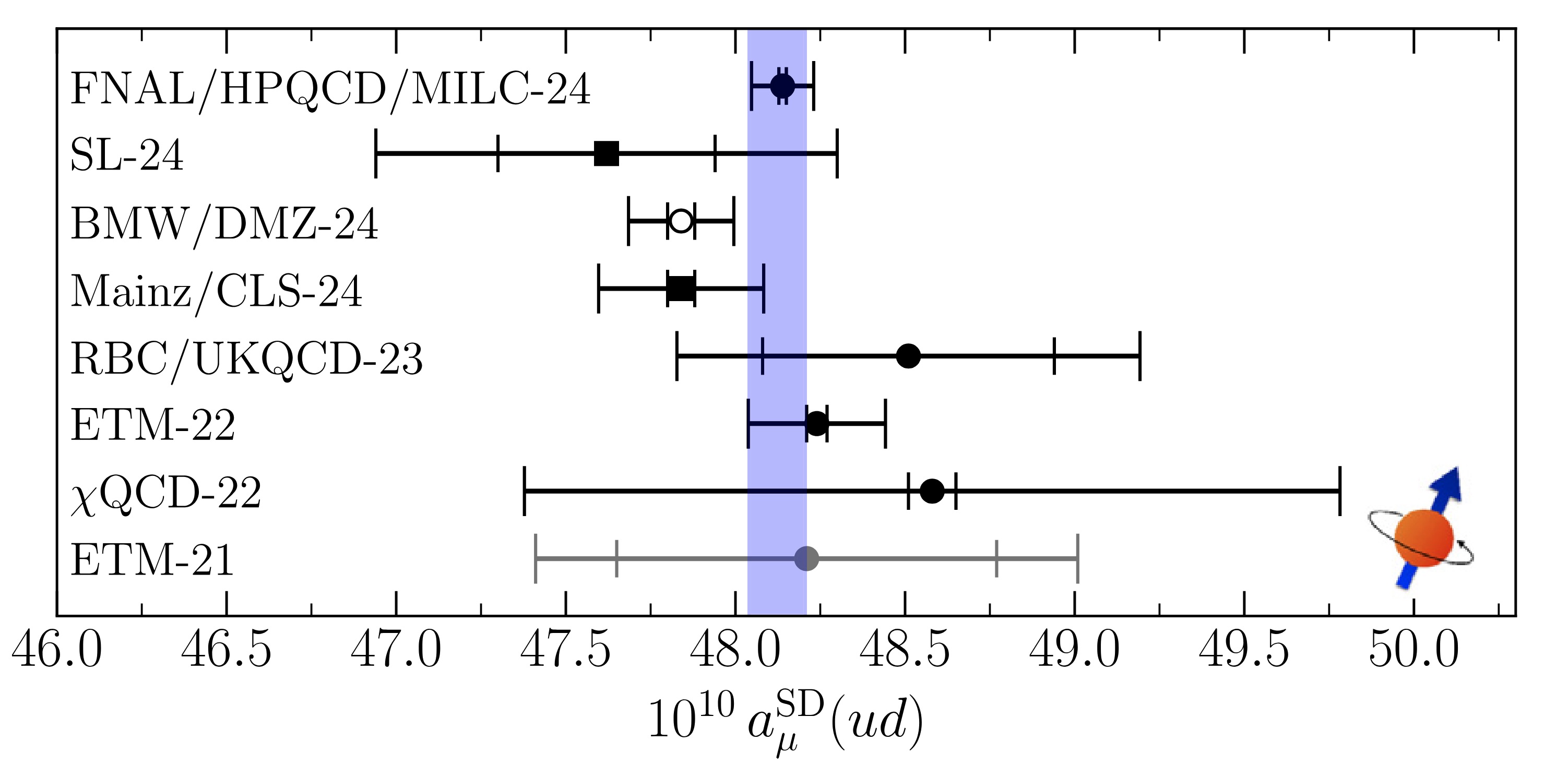
This plot is taken from the 2025 Muon $g-2$ Theory Initiative White Paper.
presentations & posters
Precision charmonium spectroscopy on CLS ensembles: an update, Lattice 2025, Mumbai
G.Bali, S.Collins, W.Söldner, S.Spiegel
Pion and kaon decay constants on CLS $N_f = 2 + 1$ ensembles, Lattice 2025, Mumbai
G.Bali, S.Collins, J.Heitger, S.Kuberski, M.Pröbstl, W.Söldner, S.Spiegel
A high-precision continuum limit study of the HVP short-distance window, Lattice 2024, Liverpool
S.Spiegel, C.Lehner
Precision charmonium spectroscopy on CLS ensembles, Lattice 2024, Liverpool
G.Bali, S.Collins, W.Söldner, S.Spiegel
life outside of work
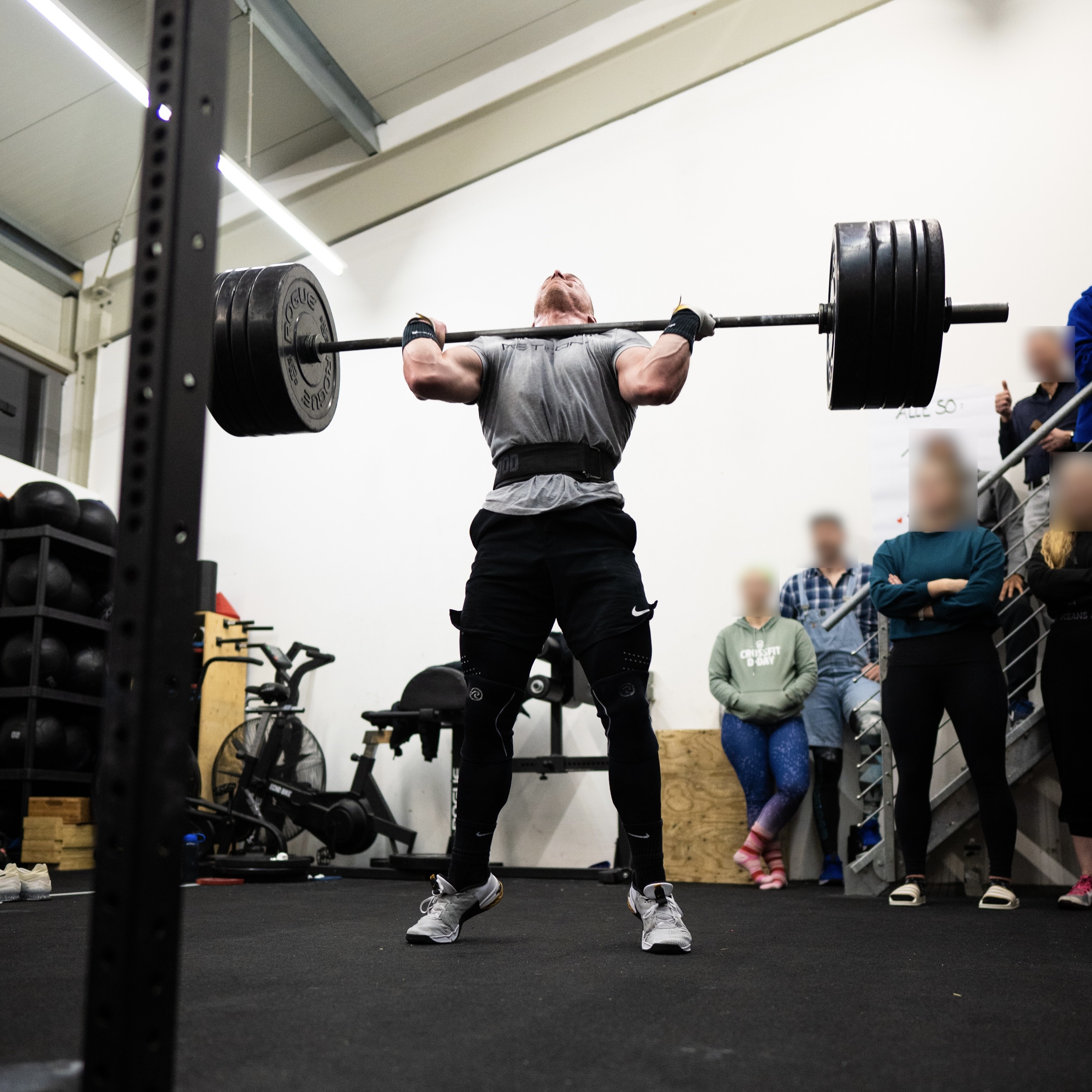
Functional fitness, Olympic weightlifting, reading, and time with friends and family.